
Automating Technical Customer Enquiries: From Email to a Verifiable Quotation Draft
Technical enquiries rarely arrive complete and neatly structured. A reliable process connects documents, product knowledge and existing systems, producing a verifiable draft rather than an autonomous quotation.
01
At first glance, a technical customer enquiry often looks straightforward: an email, two attachments and a request for a quotation. The real work begins during processing. Which version is required? Is the drawing current? Are quantities, material or delivery location missing? Does the requested variant fit the product range? And who can make a binding assessment of technical feasibility?
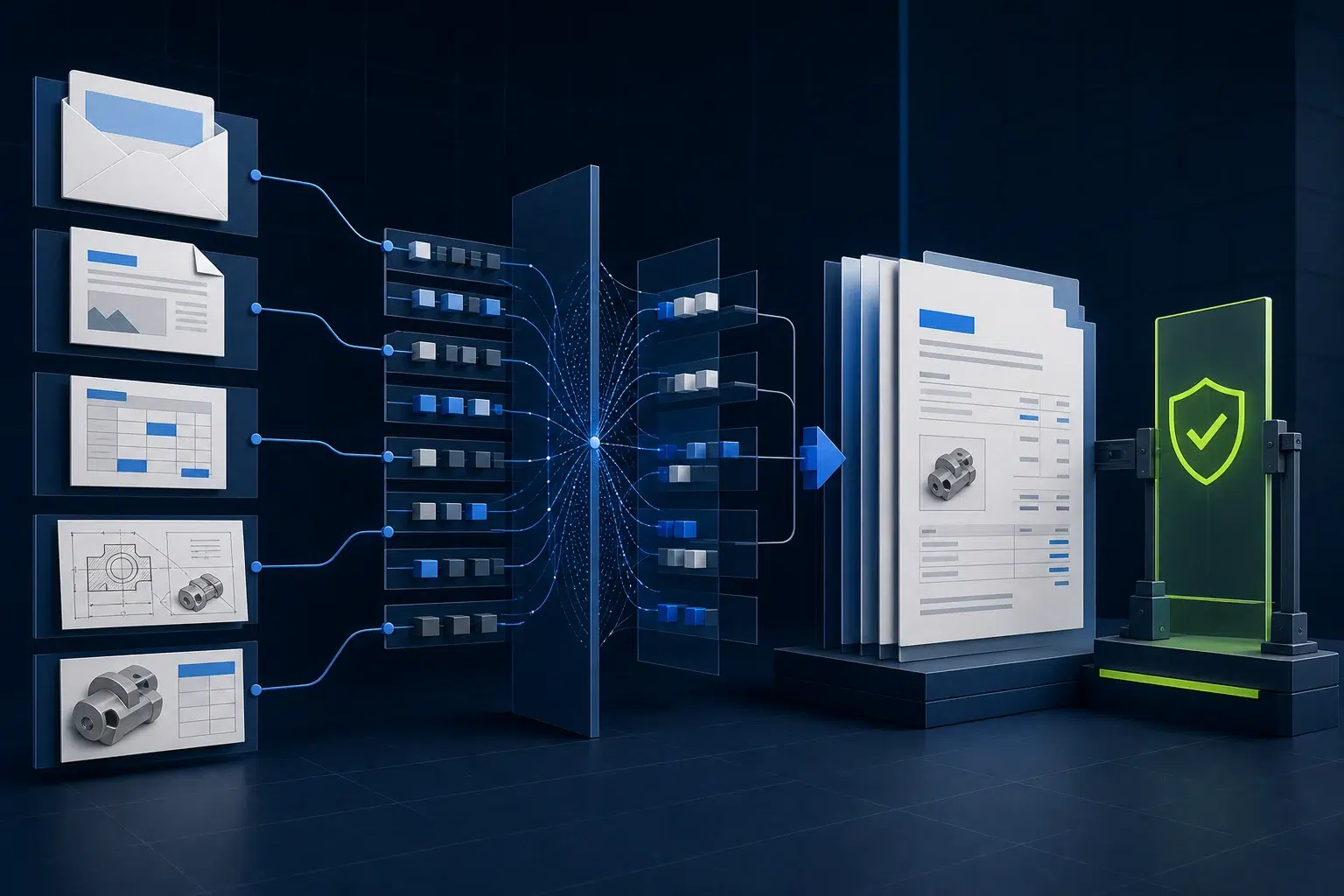
This is precisely where automation becomes useful. Not because a language model should make price commitments or send a quotation on its own, but because much of the preparation can be structured: assigning documents, capturing details, detecting missing information, finding approved knowledge and preparing a transparent draft.
The point is this: the email inbox is not what is being automated. What is automated is a clearly defined workflow between the enquiry, knowledge, systems and approval.
02
Start with the Process, Not the AI Model
Anyone who begins with the question “Which model should we use?” is usually one step too early. First, the company must understand what actually happens today. One representative enquiry is enough to begin.
For this enquiry, map the path from receipt to quotation:
- Input: Through which channel do the message and attachments arrive?
- Assignment: How does the team identify the customer, project, product group and responsible person?
- Clarification: Which required details, contradictions and technical questions are checked?
- Knowledge: Which data sheets, price versions, rules and previous solutions are consulted?
- Draft: Which information is prepared for costing, follow-up questions or the quotation?
- Approval: Who checks technical feasibility, price, availability and legal commitment?
This map reveals two things: recurring tasks that can be automated effectively, and decisions that still require subject-matter responsibility. Both belong in the same process.
03
Rules, Search, RAG and Generative AI Serve Different Purposes
Not every step needs AI. Fixed rules are usually easier to test and operate for unambiguous checks. Generative AI becomes useful when language, different document formats or multiple possible formulations are involved.
| Task | Suitable Approach | Example | Control |
|---|---|---|---|
| Assign file and case | Rules and conventional automation | Match customer number, subject, file type and existing project | Send uncertain assignments to a review queue |
| Check required information | Rule set | Are quantity, material, dimensions, standard, date and delivery location present? | Mark missing values explicitly |
| Capture free text and documents | Document recognition and language model | Structure requirements from email, PDF or bill of quantities | Show the source passage and original document |
| Find product knowledge | Search or RAG | Find relevant data sheets, variants and approved guidelines | Preserve source, version and permission information |
| Draft follow-up questions | Generative AI with a template | Create a clear draft question from missing information | Sales or engineering approves the text |
| Prepare the quotation draft | Workflow plus generative AI | Combine verified facts, assumptions and open points | Technical and commercial approval remains mandatory |
This separation is more than technical housekeeping. It makes troubleshooting easier. If a material specification is missing, it must be clear whether it was absent from the original, lost during extraction or overwritten during transfer to another system.
04
Completeness Checking Is Often the Best Starting Point
Many companies first think about the finished quotation text. That is often not the best starting point for a pilot. Greater value can be created earlier by determining whether an enquiry is ready for specialist processing at all.
Each enquiry type needs a small information model. It does not describe every conceivable field, but the information without which the next step cannot proceed meaningfully. For a technical component, this might include:
- product or product group,
- dimensions and tolerances,
- material and surface finish,
- quantity and requested date,
- applicable standards or customer requirements,
- drawing number and version,
- delivery location and any special testing or documentation requirements.
This is a simplified example, not a universal catalogue of required information. The actual attributes come from the company’s own quotation process. That is an important part of the groundwork: specialist knowledge that currently exists only as routine in the minds of individual employees becomes visible as verifiable logic.
The result must not invent missing information. If a detail is absent, it is marked as missing. If the email and drawing contradict each other, the system creates a follow-up question. A system that exposes uncertainty clearly is more valuable in a quotation process than one that elegantly conceals every gap.
05
Product Knowledge Needs Sources, Versions and Permissions
A language model alone is not enough to classify an enquiry. It does not automatically know the current prices, the approved product variant or the latest technical guideline. This knowledge must come from existing systems and documents.
RAG, which combines a language model with targeted retrieval from approved sources, can help here. The European Data Protection Supervisor describes RAG in simplified terms as the interaction of retrieval and generation, while also stressing the need to consider sensitive data, permissions, currency and possible manipulation of sources.
For the quotation process, this means:
- Every item of information used needs a visible source.
- Document version and validity must be visible.
- Retrieval may use only content the respective person is permitted to access.
- A similar previous order is a useful indication, but not proof of technical suitability or a current price.
- If no reliable source is available, the system must ask for clarification or stop.
Whether RAG is necessary depends on the sources. If product attributes are cleanly structured in the ERP or PIM, a direct query is often better. RAG is most useful where relevant knowledge is contained in data sheets, guidelines, manuals or other longer documents.
06
CRM, ERP and DMS Retain Clear Roles
New automation must not become the next data silo. It needs to define which system remains authoritative for each type of information.
One possible allocation of roles:
- CRM: customer, contact, sales opportunity, communication and processing status
- ERP: items, terms, costing, availability and commercial document
- DMS: original documents, versions and traceable filing
- Knowledge system: approved technical sources with retrieval and permissions
- Automation layer: handoffs, validation rules, logging and escalations
This is not a prescribed architecture for every system landscape. In some companies, one system performs several roles. What matters is preventing different systems from silently maintaining conflicting versions of the same case.
Write access should be introduced gradually. A pilot can initially read information only and provide a draft in a review interface. Only after assignment, permissions and error handling work reliably should the company decide which data may be written back to the CRM or ERP under controlled conditions.
07
A Quotation Draft Remains a Draft
The NIST AI Risk Management Framework recommends clearly documenting the scope, limitations, potential cost of errors and roles for human oversight. This is a sensible operating principle even outside formal high-risk scenarios.
In technical sales, the company must therefore define in advance what the reviewer can actually see and decide:
- original enquiry and attachments used,
- extracted attributes with source locations,
- missing or contradictory information,
- product and knowledge sources used,
- assumptions that still need confirmation,
- changes since the previous review,
- approval record and responsible person.
Approval is meaningful only when sufficient time, expertise and decision-making authority are available. A green button at the end of an opaque process is not effective oversight.
The BSI report on generative AI models assigns risks not only to the model but to the entire lifecycle and the specific use. For a quotation process, that means assessing the data source, processing, output, system access and operation together.
08
A Pilot Needs Real Cases and a Baseline
A sensible pilot does not begin with every product, every customer and a complete ERP integration. A limited enquiry type with enough genuine, redacted sample cases is a better starting point.
Record baseline values before building the technical solution:
| Metric | Question | What Matters |
|---|---|---|
| Processing Time | How much active work is required before specialist clarification? | Measure search, transfer and follow-up time separately |
| Completeness | Which required details are missing on receipt? | Identify missing values early and explicitly |
| Assignment | Are the customer, project, product and document version identified correctly? | Do not forward uncertain cases automatically |
| Draft quality | What specialist corrections are required? | Distinguish errors by source, rule, retrieval and wording |
| Traceability | Can every statement be verified? | Keep the source, assumption and change visible |
| Practical Value | Does the preparation genuinely help sales and engineering? | Evaluate day-to-day usefulness, not just demo quality |
The result is a clear decision: continue, make targeted improvements or stop. A pilot is valuable even when it shows that data, responsibilities or the existing process must be improved first.
09
Conclusion: Good Automation Makes Work More Verifiable
The greatest impact does not come from making a quotation generator as autonomous as possible. It comes from bringing fragmented information together earlier, exposing missing details and giving specialists a transparent draft instead of a blank document.
This requires a clear process, reliable sources, defined system roles and genuine approvals. Only then should the company decide where rules, RAG or generative AI can make the greatest contribution.
Our solution Technical Enquiry to Quotation solution shows the complete target state. If the first task is to determine which steps in the existing process are worth automating, the Quotation Process Assessment is the right starting point. For a broader assessment of further use cases, AI Consulting for Machinery Companies leads directly to a personal consultation.
The quotation process assessment costs EUR 1,900 excluding VAT. It covers one process, three to five sample enquiries, up to four systems, two joint meetings, analysis, a pilot plan and one revision round. Implementation is quoted separately.
Sources reviewed on 9 August 2026. This article describes a process and decision model, not legal advice or a system architecture that can automatically be applied to every company.
Next Step
Apply the Question to Your Own Company.
In the discovery call, we assess your specific situation and define a realistic next step.

Founder and Professional Lead of TRIXNER digital solutions. Building digital processes, integrations and applications since 2002; certified AI Automations Manager (Everlast Consulting).