
AI Agent or Classic Automation? A Decision Matrix for Companies
Not every process needs an AI agent. Often, simple automation is actually the better solution. A practical decision-making guide—without any technical jargon.
01
AI agents can quickly create the impression that every process now needs one. The more useful question is: Which solution works reliably and genuinely reduces day-to-day workload? The best solution is not automatically the one with the most AI.
A simple example: An invoice needs to be approved by a second person starting from 10,000 Euros. AI is not needed for this. A clear rule is sufficient. However, if the invoice comes as a poorly formatted PDF, the system first needs to recognize which amount, which supplier, and which cost center are meant. AI can help with this part.
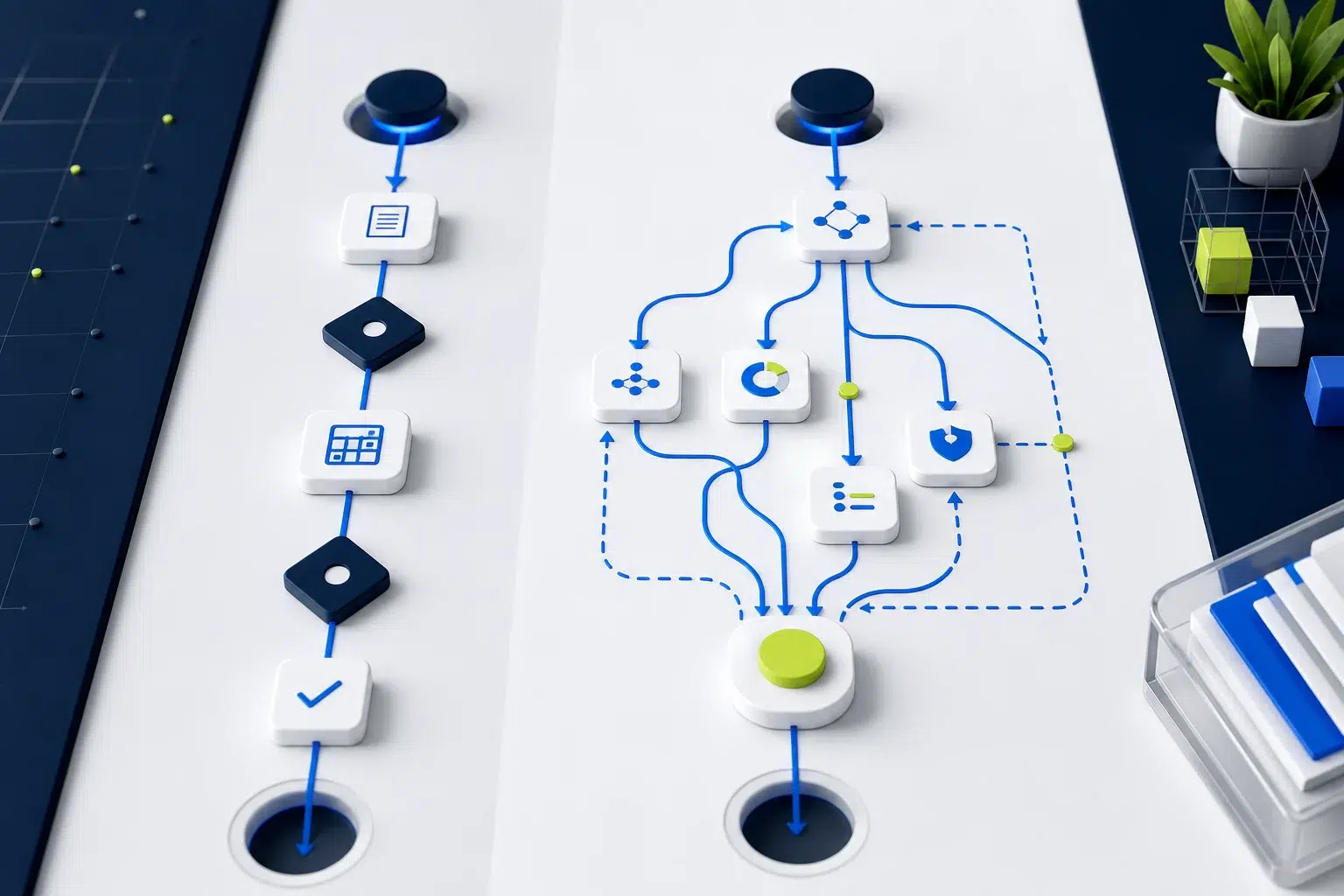
In practice, a combination is often sensible: rules handle the clear steps. AI helps with texts, documents, and unclear information. Humans make decisions where errors would have noticeable consequences.
02
Three tools, simply explained
1. Classic Automation: like a checklist
The process is precisely defined in advance: If A happens, do B. If a form is complete, it will be transferred to the CRM. If the phone number is missing, a follow-up query will be triggered. This is easy to understand, simple to test, and often more cost-effective than an AI solution.
2. AI in a process step: like a reading aid
The AI is given a clearly defined task. For example, it reads an email, recognizes the request, and suggests a category. After that, the normal process continues. Therefore, the AI cannot freely decide what happens in the company.
3. AI Agent: like an assistant with tools
An agent is given a goal and can choose multiple steps themselves. They could read a ticket, search for information in a knowledge base, create a draft response, and submit the case for approval. This is more flexible but requires clear permissions, boundaries, and complete documentation.
03
The decision matrix
| Criterion | Classic Automation | AI step | AI Agent |
|---|---|---|---|
| Inputs | Clear fields and fixed values | Texts, emails, or documents | Several different sources |
| Process | Always the same | Fixed process with one flexible task | The next step depends on the outcome |
| Error | Little leeway | The result can be checked | Needs clear boundaries and handover to humans |
| Control | The rule is directly visible | Input and output are saved | All steps and tools used are logged |
| Typical use | Transfer, check, inform | Read, match, summarize | Research, prepare, coordinate |
04
Six questions before we decide on a technique
Is the goal clearly measurable?
„We want to get faster“ is not yet a good goal. Better: Requests should be correctly assigned within five minutes. Or: Employees should only need two minutes instead of ten to prepare a ticket. Only then can it be assessed whether the solution brings any benefit.
How stable is the process?
If nobody knows exactly how a process should be handled today, AI will not improve it automatically. First clarify responsibilities and identify the exceptions that actually matter.
3. Where must it really be read or understood?
Free texts, documents, and very diverse formulations are good use cases for AI. A clear status check or copying a value from field A to field B can be better solved with normal rules.
4. What actions is the system allowed to perform?
There is a big difference between a system that merely generates a draft and one that actually modifies data, sends messages, or initiates payments. The greater the impact, the more strictly permissions and approvals must be controlled.
5. What happens in case of uncertainty?
A good system can say, „I'm not sure.“ Then the case goes to a human. That's not a mistake, but an important safety mechanism.
6. How is operations monitored?
We don't just need to see if the system runs technically. We also need to regularly check if the results are accurate from a professional standpoint. Often, sample checks, a simple feedback button, and an analysis of cases handed over to humans are sufficient for this.
05
The robust pattern: clear rules on the outside, AI on the inside
For many processes in medium-sized businesses, this setup works well:
- A clear trigger starts the process, for example, a new email.
- Check normal rules, required fields, rights, and unique information.
- AI takes on a clearly defined task, for example summarizing the concern.
- The result will be checked for format, sources, and important limit values.
- Uncertain or consequential cases are escalated to a human.
- Only after that will data be changed in the CRM, ERP, or ticketing system.
This keeps the process flexible, yet still controllable. The AI gets leeway exactly where it's useful, and not throughout the entire workflow.
06
Where people should let go
Not every process needs manual confirmation at the end. That would negate the benefit of automation. An approval makes sense where uncertainty and impact converge. A draft response to a general inquiry is different from a contract amendment or a large invoice.
Also this NIST Generative AI Profile emphasizes that risks must be continuously monitored and managed. In everyday terms, this means: Approvals, protocols, and a clear plan for exceptional cases are part of the solution.
07
Conclusion: As Simple as Possible, as Intelligent as Necessary
The clearer a process is, the less AI it needs. As soon as texts, documents, and changing situations come into play, AI can make a real difference. An agent makes sense when multiple such steps need to be connected and it remains clear what it is allowed to do.
In a structured process assessment we first separate simple rules, useful AI steps and potential agent tasks. The goal is not the most spectacular technology, but the simplest route to a better process.
Sources and Further Reading
Next Step
Apply the Question to Your Own Company.
In the discovery call, we assess your specific situation and define a realistic next step.

Founder and technical lead of Trixner digital solutions. Building digital processes, integrations and applications since 2002; certified AI Automations Manager (Everlast Consulting).